

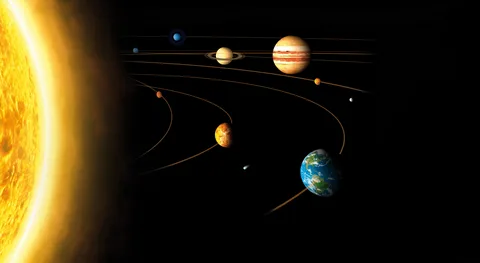
The universe has always fascinated humanity, but few topics spark as much curiosity as our own cosmic neighborhood. Exploring the Solar System: A Journey Through Planets, Moons, and Space Mysteries allows us to better understand where we come from, how planets evolve, and what secrets still remain hidden beyond Earth.
From blazing suns to icy dwarf planets, the solar system is a vast and dynamic place filled with wonders waiting to be discovered.
Introduction to Our Cosmic Neighborhood
Our solar system is centered around the Sun, a massive star that holds everything together through gravity. Orbiting it are eight planets, dozens of moons, countless asteroids, and icy comets. Each celestial body tells a unique story about the formation and evolution of space.
Exploring the Solar System: A Journey Through Planets, Moons, and Space Mysteries helps us frame this journey as more than just science—it is an exploration of time, matter, and cosmic evolution.
The Inner Planets: Rocky Worlds Close to the Sun
The inner solar system consists of Mercury, Venus, Earth, and Mars. These planets are small, dense, and primarily made of rock and metal.
- Mercury: The closest planet to the Sun, experiencing extreme temperature shifts.
- Venus: A scorching world with a thick, toxic atmosphere.
- Earth: The only known planet to support life.
- Mars: A cold desert planet with signs of ancient water flow.
These rocky planets help scientists understand how Earth-like worlds form and evolve. In fact, Exploring the Solar System: A Journey Through Planets, Moons, and Space Mysteries often begins with these four planets because they provide the most direct comparison to our own world.
The Outer Giants: Gas and Ice Worlds
Beyond Mars lie the gas giants Jupiter and Saturn, followed by the ice giants Uranus and Neptune. These massive planets are vastly different from the inner rocky worlds.
- Jupiter: The largest planet, known for its Great Red Spot storm.
- Saturn: Famous for its stunning ring system.
- Uranus: Rotates on its side, giving it unusual seasons.
- Neptune: A deep blue world with extreme winds.
When scientists engage in Exploring the Solar System: A Journey Through Planets, Moons, and Space Mysteries, the outer planets often become the most intriguing due to their complexity and scale.
Moons, Rings, and Hidden Worlds
Planets are only part of the story. The solar system also contains over 200 known moons, many of which are more geologically active than expected.
Some fascinating examples include:
- Europa (moon of Jupiter): Believed to have a subsurface ocean.
- Titan (moon of Saturn): Has lakes of liquid methane.
- Enceladus: Geysers that eject water into space.
- Earth’s Moon: Influences tides and stabilizes Earth’s rotation.
Ring systems, especially around Saturn, add another layer of beauty and complexity. These icy particles range from tiny dust grains to large chunks of rock.
Space Mysteries That Still Puzzle Scientists
Even with advanced telescopes and spacecraft, many mysteries remain unsolved:
- What lies beneath Europa’s icy crust?
- Is there a ninth planet hidden far beyond Neptune?
- How did Saturn’s rings form?
- Could life exist elsewhere in the solar system?
These questions keep astronomy evolving. Exploring the Solar System: A Journey Through Planets, Moons, and Space Mysteries is not just about what we know, but also about what we have yet to discover.
Human Exploration and Future Missions
Space agencies like NASA, ESA, and private companies continue to send missions across the solar system. Rovers on Mars, probes near Jupiter, and future missions to Saturn’s moons all aim to expand our understanding.
Future exploration may include:
- Human missions to Mars
- Ice drilling on Europa
- Atmospheric studies of Venus
- Sample returns from asteroids
Each mission brings us closer to answering fundamental questions about life and planetary origins.
Conclusion: A Never-Ending Journey
The solar system is a place of endless discovery, filled with beauty, mystery, and scientific wonder. As technology advances, so does our ability to explore deeper into space.
Ultimately, Exploring the Solar System: A Journey Through Planets, Moons, and Space Mysteries reminds us that we are part of something much larger than ourselves—a vast, evolving universe that still holds countless secrets waiting to be uncovered.
